Making RHOAI Model Inference Work for You
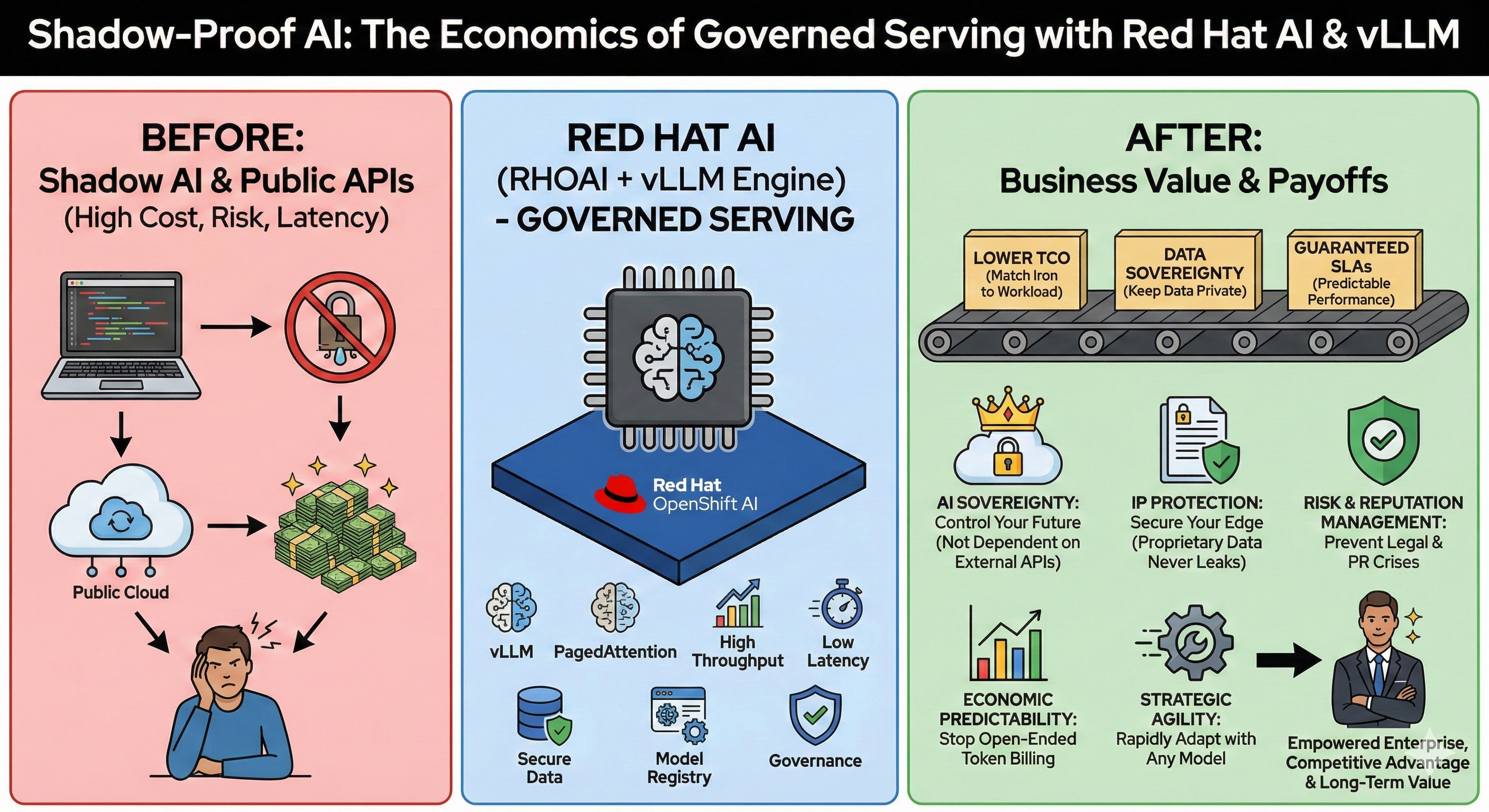
Shadow-Proof AI, The Economics of Governed Serving
Inference is where the bill arrives.
In the experimentation phase, the only metric that matters is "intelligence"—how smart is the model? But in the production phase, the metrics change. Suddenly, you are judged on latency, throughput, and cost per token.
A developer might download a 70-billion parameter model to a laptop and be impressed by its reasoning.
A platform engineer looks at that same model and sees a massive infrastructure bill, potential out-of-memory errors, and a latency bottleneck that could kill the user experience.
We are moving beyond "Shadow AI", where users blindly deploy heavy models—to a governed "industrailized approach to AI" where inference is fast, efficient, and cost-effective by design.
The Serving Workflow
In this course, we will break down the black box of model serving into a repeatable engineering process.
1. Smart Model Selection
You don’t have to benchmark 900,000 models from scratch. We will explore tools like the Red Hat AI Validated Model Catalog, which acts as a shortcut. It provides pre-vetted models with known performance profiles, allowing you to skip the "guesswork" phase and select models that are guaranteed to work on your hardware.
|
Model Catalog Simulation External Link
|
2. Hardware Sizing (The Math)
We will teach you the formula to calculate the true cost of a model.
-
Weights vs. Cache: Understanding why a model that "fits" when idle crashes when under load.
-
Quantization: How to use formats like
FP8orINT8to run massive models on smaller, cheaper GPUs without sacrificing intelligence.
3. The Engine: vLLM Tuning
We will look under the hood of vLLM, the standard inference engine for OpenShift AI. You will learn to tune critical parameters like:
-
max-model-len: Managing the context window to prevent memory overflows. -
gpu-memory-utilization: Optimizing VRAM allocation for high-throughput batching.
Our Laboratory Model: ibm-granite-3.3-2b-instruct
To practice these concepts without requiring a massive GPU cluster, we will standardize on the granite-3.3-2b-instruct model.
-
Why this model?
-
Efficiency: Its small size (3 Billion parameters) allows us to deploy it quickly and experiment with tuning parameters on standard hardware.
-
Modern Architecture: It uses the same underlying technology as massive 70B+ models, meaning the sizing and tuning lessons you learn here directly apply to enterprise-scale deployments.
-
Transparency: It is fully open-source (Apache 2.0) with disclosed training data, representing the gold standard for trusted enterprise AI.
|
Prerequisites
To successfully complete the hands-on sections of this course, you need:
|
The goal is efficient inference. Let’s start by calculating the cost.